Showing posts with label How-To. Show all posts

Friday, March 15, 2024

Wholecloth Fairmount Bag Sewalong Videos

The Fairmount Bag sewalong is now available on the Wholecloth Patterns Youtube channel. These video sewing instructions will cover every step of the Fairmount Bag sewing pattern. I've broken the sewing tutorial into two manageable sections. In Part 1 we'll cut out the pattern pieces, go over the supplies you'll need for your bag, and cut out the fabric. We'll attach the piping to the View A sides and quilt the View B sides. Then we'll prepare all the parts and pieces needed to sew the bag in Part 2. In Part 2 of the Fairmount Bag sewalong we assemble the bag. I'm demonstrating with a View A bag, but the instructions are the same for both views. 

I'm calling the Fairmount an intermediate sewing pattern because it requires a few points of precision sewing on bulky seams, but a confident beginner could tackle this bag using the sewalong. My goal was to compliment the writing and illustrations in the pattern instructions with a few tips for avoiding mistakes, and clearing the way to a successfully sewn bag. 

The video instructions are available to everyone, but you'll need a copy of the sewing pattern to make the Fairmount Bag

Basic sewing skill tutorials for the making the Fairmount Bag.

You can kick-start your Fairmount Bag sewing by prepping a few of the supplies ahead of the sewalong. You can make the perfect piping and bias tape to match your bag using the How-to Make Your Own Piping, and How-to Make Bias Tape tutorials.  If you're using a metal zipper for your bag, you'll want to shorten it to the perfect 13" using the How-to Shorten a Metal Zipper tutorial. All three are core sewing skills to add to your sewing arsenal, and the perfect place to start if you're a beginner. 

Fabrics used in the Fairmount Bags in the sewalong.

Main fabric for View A: 8.5 oz canvas in Walnut from Blackbird Fabrics
Main fabric for View B and lining of View A: Merchant and Mills Elora Indian Cotton
Lining of View B: Merchant and Mills Cara Indian Block Print
View A piping and View B pocket: Merchant & Mills Everyday Denim Chambray
All Merchant & Mills fabrics are from Oaks Fabrics

Watch the Fairmount Bag sewalong videos.

These videos are a skosh longer than my usual Youtube tutorial. You can hop around the video using the time stamps in the text below the video. Use them to rewatch the parts you need, and skip the parts you don't. Watch Part 1 Watch Part 2


Follow Wholecloth Patterns

Etsy: Wholecloth Patterns

Youtube: Wholecloth Patterns

Instagram: @_wholecloth #wholeclothpatterns

Newsletter: Join here

TikTok: @_wholecloth 


Sunday, February 25, 2024

How-to Make Your Own Piping Video Tutorial


Follow this video tutorial to make your own custom piping to match any sewing project. Piping is a crisp, classic way to add structure and define the edges of a handmade bag. The Wholecloth Patterns Fairmount Bag uses piping to define the bottom curve of view A, that might otherwise be easily crushed out of shape. It's also used on the Logan Bag to strengthen the circular bottom seam, and help hold its bucket shape. You could buy piping, but it's easy to make and gives you complete control over the look and quality of your finished bag. 

Tools for Making Piping

The only semi-specialty tool you need to make piping is the zipper foot for your sewing machine. The zipper foot allows you to sew right up against the edge of the piping cord when you're sewing the piping and when assembling your bag. The foot I use in the video is the Bernina #4. You'll want to find the foot that works with your sewing machine.  A zipper foot is essential for sewing bags, and is included with most sewing machines. 

In addition to the zipper foot you'll need a few very basic sewing tools. We'll use scissors, a marking tool, and a ruler. 

Supplies for Making Piping

Piping is basically a string wrapped in fabric. From light weight cotton lawn to upholstery fabric, any woven fabric can be used to make piping. Keep in mind that heavy fabrics will work best with thicker piping cord, and lighter fabrics will give the best coverage to thinner piping cords. In the video I'm demonstrating with light weight denim from Joann. I've also made bags piped with corduroy, or canvas. 

Of course, the filler in piping isn't actually string (although I've used yarn in a pinch). For the most predictable results use the specialty product called piping cord. My favorite is a cotton filler cord surrounded by polyester braid. The cotton is sturdy but easy to work with, and the surrounding braid allows the cord to move smoothly inside the finished fabric cover. The piping cord in the tutorial is from Great Lakes Cordage on Amazon. You can buy small quantities of many sizes of cord, and variety packs of multiple sizes. This variety pack has all 3 sizes discussed in the tutorial. It's a great way to experiment with the scale of your piping to the fabric and project. Once you try piping cord you'll never improvise with yarn or string again. 


DIY Piping is used on the Wholecloth Patterns 
sewing patterns. 


Follow Wholecloth Patterns

Etsy: Wholecloth Patterns

Youtube: Wholecloth Patterns

Instagram: @_wholecloth #wholeclothpatterns

Newsletter: Join here

TikTok: @_wholecloth 


Tuesday, February 20, 2024

How- to Make Double Fold Bias Tape Video Tutorial


Follow this video tutorial to make your own double fold bias tape for a perfect handmade seam finish. Learn what fabric to use for bias tape, how-to find the bias of your fabric, and how to make your own 1/2" double fold bias tape with common sewing tools, no gadgets needed. This technique is perfect for making the short lengths of bias tape required for bag sewing, and is used in the Wholecloth Patterns Fairmount Bag

Why make your own bias tape?

Bias bound seams are a durable and professional looking finish for bag sewing. They are also a great way to add character to your bag and continue the exterior color scheme on the interior of the bag. 

What is the best fabric for making bias tape?

Light weight woven cotton such as shirting, lawn, batiste or quilting cotton is best fabric for making bias tape. Finished bias tape has 4 layers of fabric, these light weight fabrics maintain a low profile when applied to a finished seam. Avoid heavy or bulky fabrics that will result in a bulky finished seam. Use a fabric like cotton that holds a crisp crease when ironed. You'll want your bias tape to hold its shape when you work with it, and a crisp fold will make 

In the video I use this light weight cotton hand block printed fabric from Indian Stores on Etsy. It coordinates nicely with this hand block print from the same shop. 

Tools for making bias tape.

To make your own double fold bias tape you'll need a ruler, scissors, a fabric marker and in iron. These are all basic tools you probably already have in your sewing kit. There are bias tape making gadgets, that you may want to try if you're making yards of bias tape for quilt or garment sewing, but for this tutorial we'll focus on the low tech way to make it yourself. It's perfect for the small quantities of bais tape used for bag making. 

The bias bound seam finish is used on the
 Wholecloth Patterns Fairmount Bag. 
Get the Pattern

***

Follow Wholecloth Patterns

Etsy: Wholecloth Patterns

Youtube: Wholecloth Patterns

Instagram: @_wholecloth #wholeclothpatterns

Newsletter: Join here

TikTok: @_wholecloth 


Monday, February 12, 2024

Sewing Tutorial : How-to Shorten a Metal Zipper

In the Wholecloth Patterns How-to Shorten a Metal Zipper video tutorial we'll cover the parts of a zipper, widths of zippers, lengths of zippers, and finally how to pull out some teeth, replace the top zipper stops and shorten that zipper in a way that looks as good as new. You can find the full youtube tutorial for shortening a metal zipper here. Below I'll give you the run down of the tools and supplies I used in the video. 

Where to Buy Metal Zippers for Bag Making.

Etsy has a great selection of shops selling zippers of every type. It's an easy place to shop for a specific length or color from many different stores. 

Zip It on Etsy. - Zip It has a large inventory of sizes, lengths, tape colors and metal finishes to choose from. Their shop is well organized so it's easy to sort for the zipper you're looking for. Good price for the quality, fast shipping and prompt customer service. 

Zipper Stop  - More great metal zipper options. The 14 inch #5 zippers I use in the tutorial video are from Zipper Stop. They also have prompt customer service and put together a custom color combo for me.  Zipper Stop is also on Etsy.

Wawak - Wawak has a good selection of metal zippers and (in my experience) fast shipping. 

Where to Buy Loose Zipper Stops

The little nubs above the teeth on the open end of a zipper are called the top zipper stops (see the video for full zipper anatomy). They prevent the slider  from coming off the zipper when it's fully closed. Replacing the stops on a shortened zipper makes it look brand new, and maintains its durability. The Etsy store Zipper Stop also sells zipper stops. I bought mine on Amazon for the free shipping. Be sure to buy the same size stops (see video for zipper sizing) as your zipper.  

Where to Buy Needle Nose Pliers

You can find needle nosed pliers at almost any big, or small, box hardware store. After borrowing the pliers from my husband's tool box for years, I finally upgraded to my own mini pair of needle nosed pliers. I've removed zipper teeth with regular pliers before, but it's much easier to precisely remove one tiny metal tooth at a time with pliers with a very narrow tip. I got mine as a set from Amazon. I'm pretty sure these are the pair I was borrowing from my husband. Mine are 5" in total length, very similar to these, these and these

Why Shorten a Zipper

Shorten zippers makes your sewing more efficient. The Wholecloth Patterns Tether Pouch requires 9 zippers to make a full set. It can be hard to find one shop with 3 different lengths of matching zippers in stock, or they aren't sold in sets of 3. It creates a lot of flexibility to buy longer zippers and cut them to the size needed for the pouches. The Wholecloth Patterns Fairmount Bag (coming soon!) uses a 13" top zipper. One way to achieve that size is to buy a 14" (or longer) zipper and shorten it to 13". 


Follow Wholecloth Patterns

Etsy: Wholecloth Patterns

Youtube: Wholecloth Patterns

Instagram: @_wholecloth #wholeclothpatterns

Newsletter: Join here

TikTok: @_wholecloth 

Thursday, March 15, 2018

How-To Knit a Single Row Buttonhole Video

I am a pretty big fan of the single row buttonhole. It's the buttonhole technique used in my Simple Ribbed Pixie Bonnet knitting pattern. I have knit that pattern hundreds of times, ergo I have knit hundreds of single row buttonholes!

The beauty of the single row buttonhole is that the whole thing fits within a single row. This is a great technique to learn because it's strong and doesn't take much planning. I use it a lot when I'm improvising sweaters for dolls or little kids.

The technique has a lot of steps and can seem a little complicated to new knitters. I know I prefer a video when I'm learning a new knit stitch or technique so I made one to help you through the single row buttonhole.


TEXT INSTRUCTIONS
With right side facing, move yarn to front, slip a stitch, move yarn to back and leave it there. *Slip another stitch, pass first slipped stitch over second. * Repeat part between * two more times for a total of 3 cast off stitches. Slip last slipped stitch back onto left needle. Turn work. Move yarn to back and use the cable cast-on to cast on 4 stitches on the left needle.  Slip first stitch from right needle to left needle and pass last cast on stitch over it. Slip first stitch on left needle back to right needle. Turn work, move yarn to back, continue to work the row.

You can cast off more or less stitches depending on the size of your button. Always cast on one more stitch for the top of the buttonhole than you cast off for the bottom.


Saturday, June 10, 2017

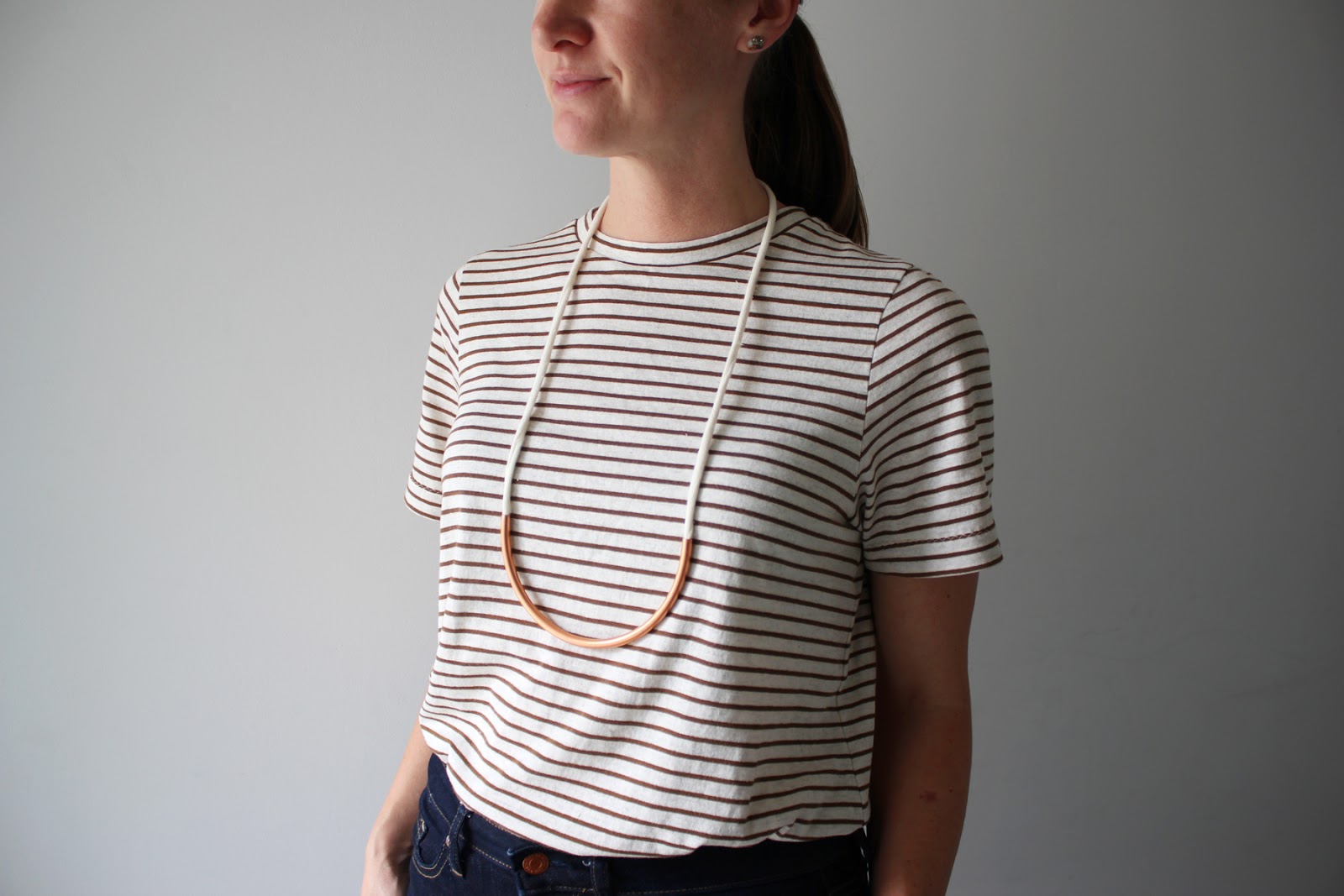
DIY Curved Tube Necklace Tutorial

My sewing super powers may have gone to my head, now I think I can make anything. Pants, sweaters, jewelry...I wanted a curved tube necklace, so I made a curved tube necklace.
Wearing a modified Lou Box Dress
The copper pipe for this necklace came from the plumbing section at Lowe's. Most hardware stores have precut short sections of small diameter copper piping for about $6. I tried this necklace with two different diameters of pipe. The one above is 1/4in inside diameter, the one below is 1/4in outside diameter. The smaller pipe is much easier to work with, and is probably the best place to start.

I was feeling pretty pleased with my $6 necklace until I saw what a pipe-cutter cost. The only one at our Lowe's was $40, pretty steep for a single DIY. Luckily, my husband has as many well stocked hobbies as I do, and he already has a very sturdy pipe cutter. If you don't see much plumbing work in your future, I think this $6 pipe cutter from Home Depot would be just fine. This copper piping is soft enough to bend with your hands, it would work with a cheap-o tool.

I used a Pyrex bowl to set the diameter of my necklaces. I experimented with parking bollards and street sign posts. They both worked just fine, but the bowl was way more convenient.

For the string, I cut a strip of cotton knit from my last cardigan. Any knit that rolls when you stretch it will work. I suggest a 1" wide strip, but you'll have to play with that to see what fits through the pipe. I prefer the rolled knit, to an actual cord because you can easily adjust the thickness to fit any size pipe. For both necklaces I made short "beads" from the pipe to add a little interest at the back.
Wearing a Jane Tee from Seamwork Magazine.


DIY CURVED TUBE NECKLACE TUTORIAL

You will need: A 1/4in OD (outside diameter) copper pipe, 12-24in long. Strip of jersey knit fabric (that will roll when stretched) approx. 1in x 48in. Something sturdy, and round with about 5in diameter. I used a Pyrex bowl.
Use the round thing as a form, and bend the copper pipe around the outside curve. Bend slowly and carefully, being careful not to kink the pipe.
Make a mark along the pipe where you would like the necklace to begin and end. I used my cutting mat to make sure the curve was symmetrical. The pipe cutter makes a slight rounded edge at the cut, so it is best to cut both ends of the pipe to ensure the finish will be similar. Align the blade of the pipe cutter with the mark. Tighten the cutter until the blade is just gripping the pipe, and twist the pipe back and foutth so the blade rolls over the entire circumference of the pipe.
Tighten the cutter a tiny bit at a time, turning the pipe along the blade, until the pipe is cut the whole way through. It is important to tighten the clamp on the cutter slowly so you don't crimp the pipe.
For my necklaces I cut the main curve, and two 3/4in long beads for each end of the string. Feed the string through each bead, and the curved piece. Depending on the thickness of your string, you may be able to do this by hand. I attached my string to the end of a pipe cleaner to feed it through the pipe.  (and now my pipe is also squeaky clean inside;)
Knot each tip, position the beads along that knot, then knot the two ends together at the desired length. That's it!

Monday, October 20, 2014

The Thumbhole Sleeve T-Shirt Experiment

Who doesn't love a thumbhole t-shirt? I love them, but I'm not a workout wear kind of girl, so I rarely wear them. No more. After a few weeks of intermittent experimentation I have cracked the thumbhole sleeve origami case wide open. Now everyday can be a thumbhole t-shirt day. 

The best part about this little customization is that it can be done with any t-shirt pattern, for children or adults. I'm demonstrating the process with the Oliver + S Field Trip Raglan, but I imagine it would work great with the Flashback Skinny, or the Recess Raglan

PREPERATION
Cut 2" off of the length of each sleeve piece. Measure the length of the resulting raw edge, you will need this measurement to make the sleeve cuffs later. Assemble the shirt as indicated in the pattern instructions. Finish the neck and bottom hem. Finish the sleeves as follows:

FOR THE CUFFS
Cut out two rectangles with a length of 10" and a width that is 90% of the length of the trimmed sleeve edge. My size 7 sleeve edge was 8" long. Here's the math:
90% of 8" is .8x8"= 7.2"
Its not an exact science so I rounded to 7.25". I cut my cuffs 7 1/4" x 10"

The cuff is sewn in three segments. The first is split by the fold at the finger edge of the cuff. The second is around the thumbhole. The third is from the thumbhole to the raw edge where it joins to the arm of the shirt.

Even if you normally serge knits, I recommend sewing the cuffs using a zigzag stitch on your sewing machine, because it is easier to control the stopping and starting point of each seam segment. I am sewing with a large zigzag stitch and a contrasting thread to make the stitching easy to see. If your stitches are showing through the final seam like mine, switch to a smaller stitch length and a tighter zigzag stitch.

FIRST SEGMENT
Fold cuff in half lengthwise with right sides together. Using a ruler mark the center of the raw long edge. Measure and mark 1" to either side of the center marking.
Remove the center marking. Using a zigzag stitch sew between the remaining markings. Be sure to backstitch securely at each end.

SECOND SEGMENT (thumbhole opening)
With the cuff positioned as shown on the left above, bring the flaps on the left side together.  
Position right sides together and aligned from the raw edge to the end of the first seam. Position so that the rest of the cuff is tucked up inside and out of the way. Place a pin at the end of the first segment of stitching, to keep the edges flat, and the rest of the cuff out of the way. Use another pin to mark 1 1/2" from the end of the first seam. Using a zigzag stitch, sew between the marks. Get as close to the end of the first seam as possible without overlapping it. It is easiest to start at the end away from the first seam. Be sure to back stitch securely at each end. 
Repeat with the other set of flaps. Turn the work to the right side (as shown above) to be sure you're on the right track. This is the thumbhole opening. 

THIRD SEGMENT
You can see in the above image that there is a set of outer flaps and a set of inner flaps. In the next step you will sew the outer flaps together, and sew the inner flaps together. 
Turn the outer flaps so that you can sew with right sides together. Sew from the bottom edge to the point where the second seam begins. Get as close as you can without overlapping. Be sure to backstitch securely at each end. Repeat with the inner set of flaps.
This is your finished cuff. Repeat with other cuff piece.
Right sides together attach the cuff piece to the sleeve. Align underarm seam of the sleeve with the seam of the cuff. This connection can be made with the serger.
Now this guy sure looks cozy!

I'm adding this humble t-shirt to the KCW pool. Are you sewing for Kid's Clothes Week? This is my first project. I have a thousand planned.


***
Featured on Oliver + S!

Tuesday, October 14, 2014

Free Toddler Witch Hat Sewing Pattern

I have a vast archive of homemade halloween costumes that I have never blogger about. If L looks conspicuously young in this photo, its because its two years old. And the hat was made almost two years before that. Yes, L was a witch for her first halloween. I wanted to make her a hat that would stay on her little toddler head, and that she would be pretty likely to keep on. The result has a very tall point, a very short brim, and very cute on a tiny little witch. 
This free pattern includes a PDF download of pattern pieces, and the pictorial instructions shown below. There are only 3 pieces to this hat, and only 4 seams to sew. I made the hat out of synthetic felt from Joann. Sewing with felt is sort of like sewing with construction paper, it's easy to work with and there are no seams to finish. All of this makes this little witch hat the perfect starter sewing project. 
For me the fun part is adding the decoration. Sure it could be a plain ol' witch hat, but I love this oversized purple felt bow. I sewed on a giant green plastic spider that was a birthday party favor, but you could use one of the mountains of spider rings your kid brought home last year, or pick some other little creepy crawly up at the party supply store. 


Download Pattern Here:

Sizing:
12 Months - 2T approximately 18 1/2" head circumference.

Supplies:
Scissors
Tape
1/2 Yard Black Craft Felt  54" Wide
Matching Thread

Optional Embelishments:
Ribbon
Yarn for pompoms
Plastic Creepy Crawlies

1. Print pattern pieces, use the 1" square box on each sheet to be sure it is the correct size.
2. Match up the grid and the letters in the corner of each page, then tape the pattern pieces together.
3. cut out each pattern piece on the cut line. Pin pattern pieces to fabric, aligning with fold where indicated, but out fabric.
5. Here are the pieces first folded in half, then unfolded. You will have cut 1 Hat Crown, and 2 Brim pieces. One will be the Top Brim, one will be the Bottom Brim.
6. Right sides together (hint - wool felt has no wrong side!), fold the crown piece in half at the fold line. Sew a line of stitching 1/2" from the open edge. Back stitch at the beginning and the end as close to the cut edge as possible. 
7.Trim the corner of the tip. Press open the resulting seam. Carefully turn the crown piece right side out. Use a knitting needle, or pencil tip, to push the tip of the cone of the crown to the sharpest point possible without pushing a hole in the end of the cone. 
8. Using a long basting stitch, sew 1/2 line around the bottom brim piece. Trim from edge up to (but not through) the line of basting at 1" intervals. Flatten the tabs to be perpendicular to the cone of the crown.
9. Place the top brim over the point of the crown. Align the inside edge of the top brim piece with the basted line on the crown. Pin the top brim to the tabs along the bottom edge of the crown making sure they are flat up against the top brim piece. Sew the crown to the top brim by sewing a seam 1/8" from the inside edge of the top brim.  
10. Place the Crown/Top Brim assembly on top of the Bottom Brim piece. Make sure that all of the edges of the two Brim pieces align, and that the tabs of the Crown are sandwiched between the two Brim pieces. Pin along the inside and outside edges.
11. Sew the Bottom Brim piece to the Top Brim/Crown assembly 1/4" from the inner edge of the Top Crown piece. Sew the two Brims together 1/4" from the outer Brim edge.
12. Lightly press your hat (make sure to use the lowest setting on your iron if you are using synthetic felt). Embellish as desired. 

This is my first attempt at multi piece pattern sharing.  Please send any helpful feedback to:
 sweetkm1 (at) yahoo (dot) com 
Share your finished projects on instagram:
#sweetkmpatterns